
Ipamorelin & CJC-1295 (DAC vs. No DAC): Pulsatile GH Release vs. Continuous Elevation in Preclinical Research
In pituitary endocrinology and somatotropic axis modeling, the combination of Ipamorelin (Ipamorelin) and CJC-1295 (CJC-1295) represents the primary dual-pathway benchmark for stimulating endogenous growth hormone (GH) secretion. While both agents trigger somatotroph degranulation, they operate through completely orthogonal cell-surface receptors: the growth hormone secretagogue receptor 1a (GHS-R1a) and the growth hormone-releasing hormone receptor (GHRH-R).
A critical variable in experimental laboratory design is the structural choice between CJC-1295 with DAC (Drug Affinity Complex) and CJC-1295 without DAC (modified GRF 1-29). This molecular distinction governs whether somatotropic signaling follows a physiological, pulsatile rhythm or induces sustained, steady-state hormonal elevation in preclinical animal models.
Molecular Structures, Sequences, and Chemical Modification
Understanding peptide half-life, proteolytic resistance, and receptor kinetics requires an examination of the synthetic modifications made to native GHRH and ghrelin peptide structures.
1. Ipamorelin: Selective Pentapeptide Ghrelin Mimetic
- Chemical Formula: C38H49N9O5
- Molecular Mass: 711.86 g/mol
- Amino Acid Sequence: Aib-His-D-2-Nal-D-Phe-Lys-NH2
- Structural Design: Ipamorelin is a synthetic pentapeptide featuring non-coded amino acids, including alpha-aminoisobutyric acid (Aib), D-2-naphthylalanine (D-2-Nal), and D-phenylalanine. This tailored configuration provides high resistance against aminopeptidases while conferring strict binding selectivity for GHS-R1a.
2. CJC-1295 (No DAC / Modified GRF 1-29): Pulsatile GHRH Analogue
- Chemical Formula: C152H252N44O42
- Molecular Mass: 3,367.97 g/mol
- Amino Acid Sequence: Tyr-D-Ala-Asp-Ala-Ile-Phe-Thr-Gln-Ser-Tyr-Arg-Lys-Val-Leu-Ala-Gln-Leu-Ser-Ala-Arg-Lys-Leu-Leu-Gln-Asp-Ile-Leu-Ser-Arg-NH2
- Structural Design: Modified GRF 1-29 comprises the first 29 amino acids of native GHRH (which retains 100% biological activity). It incorporates four amino acid substitutions (D-Ala2, Gln8, Ala15, and Leu27) to block dipeptidyl peptidase-4 (DPP-4) cleavage and oxidative degradation. Its free in vivo research half-life is approximately 30 minutes.
3. CJC-1295 with DAC: Covalent Bioconjugate for Sustained Signaling
- Chemical Formula: C165H269N47O46
- Molecular Mass: 3,647.28 g/mol
- Structural Design: CJC-1295 with DAC appends a maleimidopropionic acid linker to the C-terminal lysine residue via a mini-PEG spacer. Upon introduction to biological serum, the maleimide moiety forms a stable, covalent thioether bond specifically with the free thiol group on Cys34 of circulating serum albumin. This bioconjugation extends its circulating terminal half-life to roughly 6 to 8 days in laboratory models.
Receptor Pharmacology and Downstream Pituitary Cascades
Combining a GHRH analogue with a ghrelin receptor agonist achieves marked somatotroph synergy by concurrently activating two distinct intracellular second-messenger pathways.
Dual Intracellular Synergy: PKA and PKC Crosstalk
- The GHRH-R / cAMP / PKA Axis (CJC-1295): CJC-1295 binds to the G-protein coupled GHRH receptor on anterior pituitary somatotrophs. This couples to the Gαs subunit, activating adenylate cyclase. Adenylate cyclase converts ATP to cyclic adenosine monophosphate (cAMP), activating Protein Kinase A (PKA). PKA phosphorylates L-type voltage-gated calcium channels, promoting an influx of extracellular Ca2+ that drives baseline growth hormone vesicle exocytosis.
- The GHS-R1a / IP3 / PKC Axis (Ipamorelin): Ipamorelin selectively docks at GHS-R1a, which couples via the Gαq/11 subunit. This activates phospholipase C (PLC), cleaving phosphatidylinositol 4,5-bisphosphate (PIP2) into inositol 1,4,5-trisphosphate (IP3) and diacylglycerol (DAG). IP3 binds to receptors on the endoplasmic reticulum to release intracellular Ca2+ stores, while DAG stimulates Protein Kinase C (PKC).
- Synergistic GH Amplification: When both pathways fire simultaneously, the combined spike in intracellular free Ca2+ produces a supra-additive degranulation of stored GH that significantly exceeds the sum of either compound tested alone. Furthermore, GHRH signaling suppresses somatostatin tone at the pituitary level, permitting maximum secretagogue response.
Ipamorelin Receptor Selectivity Profile
Unlike early generation GH secretagogues (such as GHRP-2 and GHRP-6), competitive binding assays demonstrate that Ipamorelin does not interact with the melanocortin, opioid, or adrenergic receptor systems. In vitro pituitary tissue assays demonstrate that even at supraphysiological concentrations, Ipamorelin does not trigger significant co-release of adrenocorticotropic hormone (ACTH), cortisol, prolactin, or aldosterone, preserving a clean endocrine isolation of the somatotropic axis.
Preclinical Comparison: CJC-1295 (No DAC) vs. CJC-1295 (With DAC)
Choosing between DAC and No DAC depends on the endocrine dynamics required by the experimental model:
| Pharmacokinetic / Assays Feature | CJC-1295 (No DAC / Mod GRF 1-29) | CJC-1295 (With DAC) |
|---|---|---|
| Chemical Modification | 4 amino-acid substitutions | 4 substitutions + maleimidopropionic acid linker |
| Albumin Binding Mechanism | None (unconjugated free peptide) | Covalent thioether linkage to Cys34 of albumin |
| Preclinical Half-Life | ~30 minutes | ~6 to 8 days |
| GH Secretion Pattern | Discrete, pulsatile episodic bursts | Continuous, elevated baseline (elevated trough) |
| Pituitary Desensitization Risk | Negligible (preserves natural refractory pause) | Moderate (potential receptor down-regulation over extended cycles) |
| Preferred Experimental Model | Pulsatile GH dynamics, sleep-wake axis modeling | Chronic systemic catabolism, sustained IGF-1 elevation |
Preclinical Phenotypic Observations
Pulsatile Secretion and Pituitary Sensitivity Preservation
In animal models, co-incubating or co-administering Ipamorelin with CJC-1295 (No DAC) replicates the natural, high-amplitude ultradian rhythm of growth hormone release. Because the systemic half-life of No DAC is limited to 30 minutes, somatotroph cells experience natural inter-pulse refractory intervals. This prevents receptor internalization, minimizes GHRH-R desensitization, and maintains consistent pituitary responsiveness across extended multi-week research assays.
Hepatic IGF-1 mRNA Induction and Tissue Partitioning
While pulsatile protocols using Mod GRF 1-29 trigger sharp GH peaks that stimulate peripheral lipolysis and cellular nitrogen retention, CJC-1295 with DAC drives a continuous, sustained baseline elevation of serum GH. Preclinical models indicate that continuous GH elevation causes hepatic over-expression of insulin-like growth factor-1 (IGF-1) mRNA, resulting in higher continuous serum IGF-1 concentrations with fewer intermittent peaks.
Laboratory Handling and Reconstitution Parameters
To preserve peptide tertiary conformation and maintain analytical purity, execute the following reconstitution parameters — see our storage and cold chain for the shipping side:
- Lyophilized Powder Storage: Store unopened research vials at −20 °C. Samples remain stable up to 24 months. Protect from direct ultraviolet exposure.
- Solvent Selection: Reconstitute with Bacteriostatic Water (0.9% Benzyl Alcohol) for multi-entry analytical sampling, or Sterile Deionized Water (0.9% Saline) for immediate cell-culture plate assays.
- Solubilization Technique: Depress the diluent needle along the inner glass sidewall. Allow the liquid to passively wet the lyophilized pellet. Gently swirl the vial in an orbital motion. Do not vortex, shake, or mechanically agitate, as high-shear physical forces cause foaming and denature synthetic peptide chains.
- Aqueous Stability: Once dissolved, maintain solution aliquots at 2 °C to 8 °C. Use within 28 days to prevent hydrolytic degradation or deamidation of asparagine/glutamine residues.
Frequently Asked Questions
Why is Ipamorelin preferred over GHRP-6 or GHRP-2 in endocrine research?
Ipamorelin is chemically engineered for complete binding selectivity at the GHS-R1a receptor. GHRP-6 stimulates intense appetite signaling through broad central receptor cross-talk, and GHRP-2 triggers secondary elevations in cortisol and prolactin. Ipamorelin stimulates somatotroph degranulation without disturbing ACTH, prolactin, or cortisol baselines.
What is the functional advantage of adding DAC to CJC-1295?
The Drug Affinity Complex (DAC) permits spontaneous covalent bonding to endogenous albumin. This shields the GHRH sequence from enzymatic degradation by DPP-4 and prevents rapid glomerular filtration, extending the circulating peptide half-life from 30 minutes to over 6 days in animal studies.
Can Ipamorelin and CJC-1295 be co-reconstituted in the same vial?
In analytical research and in vitro experiments requiring fixed stoichiometry (e.g., a 1:1 molar ratio), researchers often co-dissolve both lyophilized powders in the same sterile vehicle. However, to preserve variable dose titration and prevent any physical cross-aggregation during multi-week cold storage, reconstituting and maintaining them in separate vials is the recommended laboratory standard.
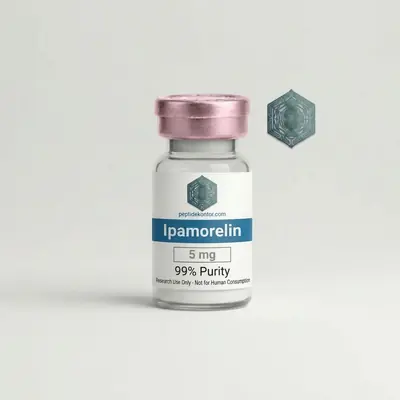
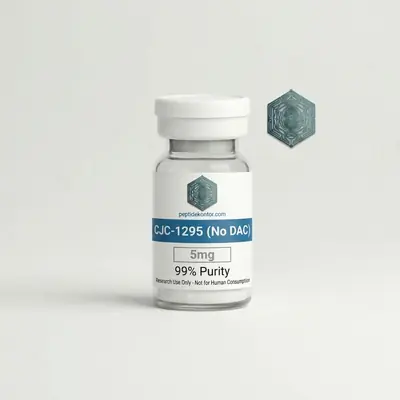
Compounds referenced
Every compound discussed above, with its current certificate of analysis.
More research notes
- BPC-157 and TB-500: The Molecular Synergy of Angiogenesis and Actin Upregulation
- Semaglutide vs. Tirzepatide: Comparing Mono-GLP-1 and Dual GLP-1/GIP Agonism in Laboratory Models
- How to read a peptide certificate of analysis
- Endotoxin testing: the assay that decides whether a batch is usable
- The five research categories, and what distinguishes them
- Choosing a fill size: 5 mg, 10 mg or 20 mg