
The five research categories, and what distinguishes them
The catalogue is grouped into five categories. The grouping is a navigation aid rather than a scientific taxonomy — several compounds sit in more than one box — but it maps onto receptor families closely enough to be useful, and it is the fastest way to narrow a broad research question into a shortlist.
Recovery & repair
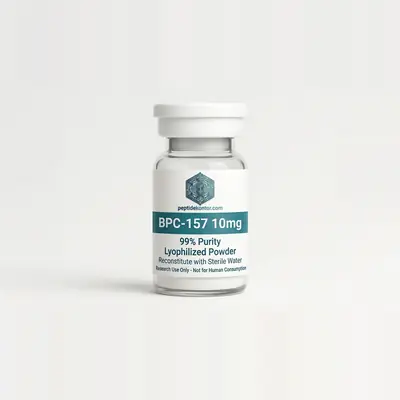
Peptides studied in the context of soft-tissue repair, largely because of their activity in animal models of ligament, tendon and gut injury. BPC-157 is the most widely referenced, and TB-500 is the usual pairing for it in dual-peptide models. The category name describes the research area, not a clinical claim.
Growth & performance
Growth-hormone secretagogues and their analogues — peptides studied for their effect on GH release and downstream signalling. They split into two groups: GHRP-class agonists such as GHRP-2, and the GHRH analogues such as CJC-1295 and the modified GRF fragment. Ipamorelin is a selective member of this group, and HGH Fragment 176-191 is the C-terminal fragment studied for activity without full GH release.
Metabolic & GLP-1
Receptor agonists studied in metabolic research, dominated by the incretin mimetics. Semaglutide and Tirzepatide are the two long-acting GLP-1-class agents here, and AOD-9604 is studied for a different receptor interaction. Semaglutide and tirzepatide are the two products where stereochemistry is essential to identity, so their mass spec confirmation matters more than most.
Longevity & cognitive
The most heterogeneous category: Epithalon (a synthetic tetrapeptide), the anxiolytic peptide Selank, and NAD+ as a cofactor rather than a peptide at all. Each is stable, small and inexpensive to make, which is why they are frequently chosen as synthesis and QC training material.
Tanning
Melanocortin receptor agonists, chiefly Melanotan II, studied for pigmentary effects via MC1R. Melanotan II carries a well-documented phototoxicity profile, which is the reason this category has its own COA emphasis.
Where the categories overlap
Two overlaps come up repeatedly. Repair peptides and GH-axis peptides are studied together often enough that buyers usually order BPC-157 and TB-500 from the same lot. And CJC-1295 without its DAC modification occupies an awkward spot — the non-DAC form is short-lived, which is exactly what the longer-acting variants were developed to address, so the two are usually discussed as a pair rather than as separate products.
The practical point: a category is a starting position for research, not a boundary. If you arrive at a question from the receptor side rather than the compound side, browse the full catalogue and filter by the family you are working with.
Composants cités
Chaque composé mentionné ci-dessus, avec son certificat d’analyse actuel.




Plus de notes de recherche
- Ipamorelin & CJC-1295 (DAC vs. No DAC): Pulsatile GH Release vs. Continuous Elevation in Preclinical Research
- BPC-157 and TB-500: The Molecular Synergy of Angiogenesis and Actin Upregulation
- Semaglutide vs. Tirzepatide: Comparing Mono-GLP-1 and Dual GLP-1/GIP Agonism in Laboratory Models
- HPLC purity vs mass spec identity: what each assay actually proves
- Endotoxin testing: the assay that decides whether a batch is usable
- Choosing a fill size: 5 mg, 10 mg or 20 mg